
Business
Integrated Development of Lab Automation Systems
Our main work is to bring together a variety of experimental instruments, measuring devices, and components, and to build automation systems that researchers can orchestrate in a form they find easy to use. From automation that makes use of existing equipment to launching new experimental setups and instrument-level custom development, we respond to the application and scale.
BUSINESS 01
Orchestration Platform & Automation System Development
We develop our own platform for orchestrating experimental instruments across makers, and build automation systems on top of it. We bring instruments that differ in maker, standard, and communication method onto a common platform, rebuilt so they can be run easily from applications. Beyond a GUI operated by people and links to other systems, the platform also supports autonomous control by an AI, and instruments can be driven while their state is observed, which suits long-running autonomous operation.
Orchestration of experimental instruments (instrument-level integration)
We combine existing experimental and measuring instruments and develop programs and systems that orchestrate several devices as a single experimental procedure. Instruments that differ in maker and communication method, such as microscopes, transfer units, dispensers, measuring instruments, scanners, and robots, are brought onto a common platform. This covers not only lab experiments but also inspection processes and production lines.
Example: a sequence of experiment automation linking five instruments (dispensing → transfer → measurement → scanning → sealing)
Integrated control of custom instruments and OEM (component-level integration)
When a customer wants a particular instrument, we design and build it from the component level and finish it as a single system together with integrated control software. Working with instrument makers and trading companies where needed, we handle everything from the concept to building the equipment and implementing its control. We meet requirements that off-the-shelf products cannot, and build instruments suited to the research and the use.
How it works: concept design → component selection → building → control implementation → integration testing
BUSINESS 02
Applying Automation Technologies & Product Development
In any integration, orchestrating several instruments and developing the integrated control software is at the center. On top of that, we develop and test the following technologies as each project needs.
IoT-enabling and smartizing existing instruments
We help make existing instruments and commercial products easier to control from the outside, through API work and mechanisms that let them be operated from external systems. We bring the instruments already on site into the scope of automation while keeping them in use.
Image analysis, data processing, and GUI development
Beyond running the instruments, we also develop image analysis models, build GUIs for displaying and correcting data, and design how analysis results feed into the next instrument's control. We automate the flow from imaging through analysis to processing.
Toward AI-driven research automation
Beyond dialogue and voice operation and automatic code generation, we also work on AI-driven research automation, where an AI interprets results and suggests the next move, or controls instruments autonomously. We design automation in which AI and people work together, on the premise of a human-in-the-loop for the points that researchers should judge.
BUSINESS 03
In-house Automation Hardware Development
We also develop our own hardware designed to work with external systems. Being able to design and build with the instrument's own constraints and handling in mind is the foundation of our integration work.
OpenScope (a Web API–controlled microscope)
A microscope you can control over a Web API. You can automate observation in a few lines of code, and because it connects easily to outside devices and systems, it suits the automation of high-mix, low-volume procedures. Linking it with robots, managing data, and combining it with AI-based analysis are all straightforward.
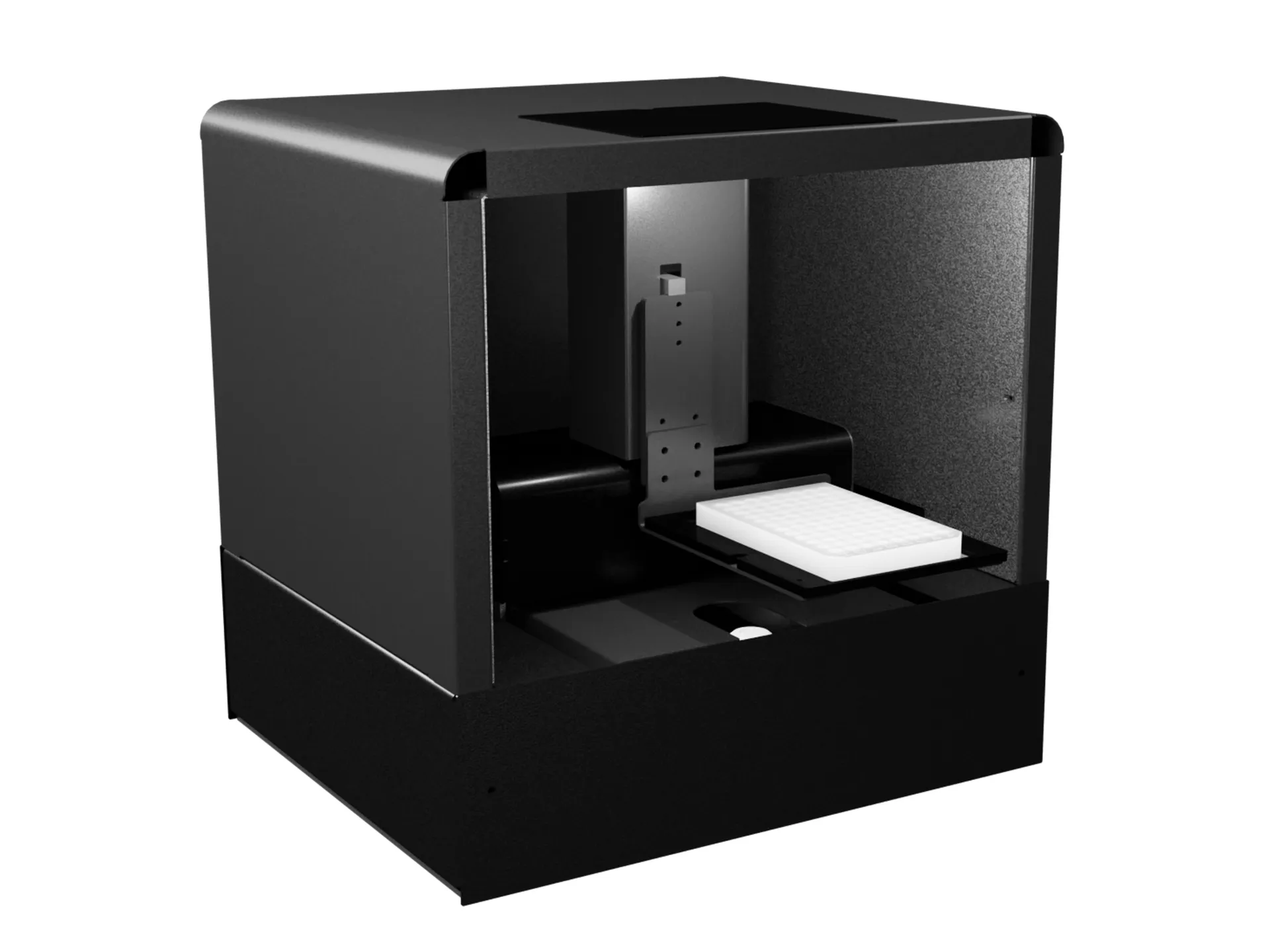
OpenHandler (a Web API–controlled transfer unit)
A transfer unit you can control over a Web API. With a simple design that keeps the number of axes to a minimum, path design, point teaching, and control are all easy. It needs no setup; once powered on it can be operated from outside right away, and it combines well with a wide range of instruments.
Custom experimental equipment
To match a researcher's needs, we design and build instruments with just the functions required, drawing on broad hardware experience in actuators, sensors, and liquid-handling mechanisms. Past work includes custom imaging systems combining transfer and optical mechanisms, and spectrometers fitted with high-precision actuators and sensors.
Case Studies
Our track record is not about selling particular instruments, but about combining several instruments and technologies into automation systems that actually run. It started in the life sciences and has grown into materials, manufacturing, and quality assurance.
For a biological testing company
Automating viral safety testing
embrio's role: microscope, image analysis model, dedicated application development
For a life sciences lab
Experiment automation orchestrating several instruments
embrio's role: supplying a transfer unit and orchestration control software
For a measurement-instrument integrator
Joint development of a custom spectrometer
embrio's role: providing the integrated control program
For a metalworking manufacturer
Support for launching an automation line
embrio's role: image analysis model and instrument control software
For a measurement-instrument manufacturer
Automating measurement-accuracy inspection
embrio's role: instrument control software and interface
For a food manufacturer
Automating the quality-assurance process
embrio's role: hardware selection and control software development

We also accept consultations for commissioned development and requests for product demos.
Please contact us via the inquiry form.
© 2026 embrio LLC. All Rights Reserved.